
Weeds are one of the major factors that hinder the growth of crops. This is because of the fact that weeds act as competitors for the crops with respect to water, nutrition, sunlight, and space, especially at the early stage of healthy crop development. At this juncture, weed management becomes essential.
Two things are always taken into account when talking about herbicides. These are pre-emergence and post-emergence weed killers. Although sounding alike, the applications of both the above terms are totally different from each other. It becomes imperative on our part to know about both these terms in order to keep our field free from weeds throughout the year.
What Is Pre-Emergence Herbicide?
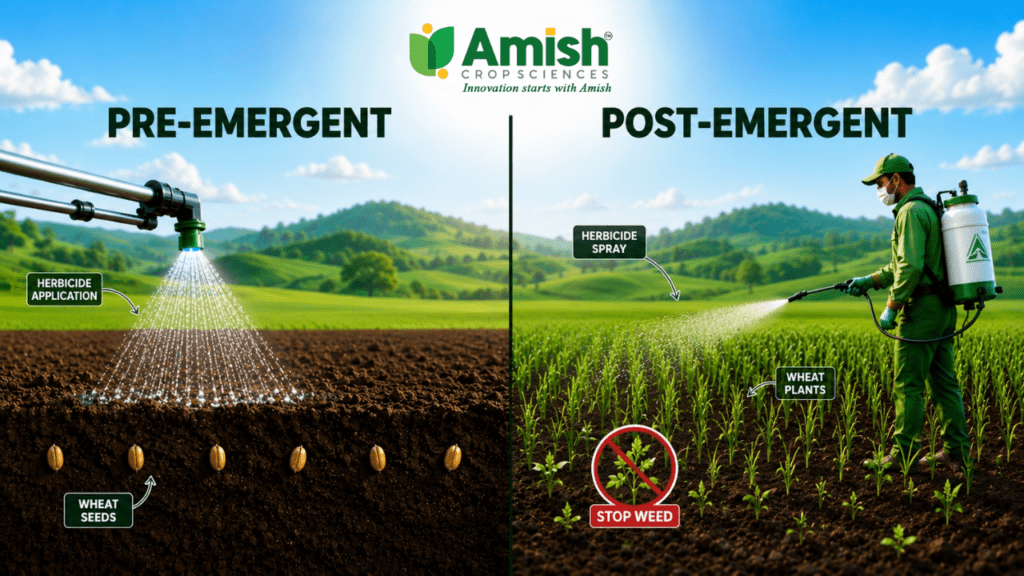
Pre-emergence herbicides are applied to the soil prior to the emergence of weeds from seeds. They are sprayed after planting crops but before the emergence of weeds. Rather than eliminating established weeds, they serve as a chemical barrier in the topsoil that makes it impossible for weed seedlings to emerge into the ground.
Example: Erin is a pre-emergence herbicide for rice that provides effective control of weeds during the early stages of crop growth, supporting healthy crop establishment.
Pre-emergence herbicides function in a preventive manner rather than a curative one. The period immediately after planting crops, when crops compete with weeds for water, nutrients, light, and space, is crucial for crop growth and development. It lasts about 20–30 days.
The efficacy of pre-emergence herbicides depends on having sufficient moisture content in the soil. Erin should be applied to soil with adequate moisture because moisture aids in the activation of the herbicide so that it can form a uniform layer of protection in the upper soil layer.
What Is a Post-Emergence Herbicide?
The post-emergence herbicide is applied after the weeds have emerged from the soil. This herbicide enters the living weed and hinders certain processes occurring within the weed, which ultimately leads to the death of the weed. Post-emergence herbicides have high efficiency since the weed is visible in the field, and hence the right type of herbicide is selected based on the type of weed.
Example: Agripeno is a post-emergence herbicide for rice that effectively controls emerged weeds, helping protect the crop from weed competition during the growing season.
The efficiency of post-emergence herbicides depends highly on the time of spraying the herbicide. Post-emergence herbicides should be applied to the young, actively growing weeds to have the best performance. Delaying the application of the herbicide until the weeds grow may reduce the effectiveness of the herbicide.
Why Choosing Just One Isn’t Enough
Both pre-emergence and post-emergence herbicides can be used in weed management; however, relying on any one of them alone cannot provide complete weed control. The best method of weed control is the use of both pre-emergence and post-emergence herbicides.
The pre-emergence herbicides prevent weeds from coming up. This reduces weed competition early on in crop growth and allows them to get a good head start. Nonetheless, some weeds may still come up because of various environmental factors and herbicide application issues. Then, the post-emergence herbicides are applied for weed elimination.
The integration of both herbicide types is very important for achieving better weed elimination and protecting crop production while making the use of farm inputs efficient.
Another significant factor in this context is the resistance of the weeds to herbicides. It happens when the same post-emergence herbicide is repeatedly used for weed control. Herbicide rotation and pre-emergence herbicides are very useful in this situation.
Finding the Right Herbicide for Weed Control
There is no single herbicide that would be good for all fields and situations in which crops are cultivated. The use of the proper herbicide is based on criteria such as the type of crop, type of weed species, soil characteristics, water conditions, as well as crop growth stage.
Example: Tembron is a post-emergence herbicide for maize that provides reliable control of weeds when applied at the recommended crop stage and according to label directions.
Can Pre-Emergence and Post-Emergence Herbicides Be Used Together?
For some cropping systems, a sequential weed management program is suggested. In such a case, a pre-emergence herbicide treatment will be supplemented by a post-emergence herbicide if more weed control is necessary.
The goal is not to raise the herbicide application rate but to ensure effective management of various flushes of weeds as well as to ensure that weed control will be sustained during the critical periods of crop development.
But it should always be remembered that tank mixing or sequential application should be done only if the products can be mixed, and the mixture or mode of application has been specifically mentioned in the product label.
Building a Practical Weed Management Plan
Generally, a good approach towards weed control involves the following pattern:
- Application of pre-emergence herbicide right after planting, where there is sufficient soil moisture.
- Scouting in the next few weeks to detect any weeds growing on the farm.
- If weeds emerge, apply a post-emergence herbicide when they are still small and easy to control.
- Rotation of the various classes of herbicides each season to minimize resistance build-up.
- Ensuring field hygiene through the use of clean seed, clean implements, and weed-free bunds.
FAQs
A. In the pre-emergence herbicide condition, there are no weeds on the farm; to put it simply, the herbicide is applied to the soil to stop the seeds from germinating.
A. Yes, you can apply both pre-emergence and post-emergence herbicides because the pre-emergence herbicide will remove all the weeds, while the remaining weeds will be removed by using a post-emergence herbicide.
A. The major error made while applying this herbicide is inadequate soil moisture content during application because of the need for water is needed to allow the herbicide to coat the soil. Another frequent error is using pesticides after the weeds have sprouted.
A. Where removal of young weeds is concerned, post-emergence herbicides are highly effective. But the more mature the plant grows, the harder it becomes to uproot. Therefore, it would be wiser to remove the weed when it is young.
A. The kind of soil, your crop and weeds, and the circumstances surrounding the chemical’s application all play a role. Consulting a reliable chemical manufacturer or an agronomist could make sense.
The Bottom Line
Pre-emergence and post-emergence herbicides are not alternatives but rather two complementary approaches to addressing the same problem. While the former is responsible for preventing most problems in the first place, the latter will take care of anything that slips through. It is common knowledge that those who combine both methods, using them appropriately according to their soil and crops’ needs, will enjoy cleaner fields and better harvests.
Choosing the right herbicide for crop protection makes the whole process much easier. Here at Amish Crop Sciences, we partner with our customers hand in hand to offer the right balance of pre- and post-emergence solutions for maximum crop protection.
Follow us on Instagram.