
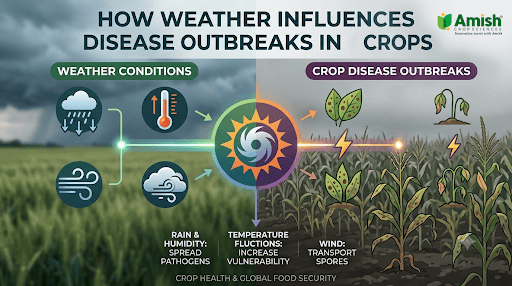
Weather is one of the critical factors that affect crop health and crop production in general. Although good weather ensures that plants grow healthily, changes in environmental factors may rapidly create the perfect conditions for developing and spreading various diseases caused by fungi, bacteria, and viruses.
Too much rain, humid weather, changes in temperatures, unexpected weather, and strong winds may result in higher risks of developing diseases in crops by creating perfect conditions for pathogens to thrive and spread. Such conditions weaken crops and lower their vigor, thus negatively affecting crop production.
To prevent such problems, it is necessary to understand how weather conditions affect the development of crop diseases.
What Is The Impact Of Weather On Crop Diseases?
Just like human beings, plants are vulnerable to any drastic change in the environment where they thrive. Fungi, bacteria, & viruses that cause diseases in plants require specific conditions for survival & multiplication. This is why, just like the seasonal flu for human beings, disease epidemics follow a certain pattern. Just like certain months have high incidences of respiratory & viral infections among human beings, there are certain seasons when plants become affected by diseases.
Key Weather Factors That Influence Disease Development
A few weather factors take on the bulk of responsibility for the initiation of disease outbreaks in the field:
- Humidity/Moisture – A humid atmosphere results in more moisture being present on the leaves’ surfaces, which is precisely the requirement for fungi to germinate and infect the plant. This is the primary factor responsible for causing many diseases like Powdery Mildew during warm and humid days where there is inadequate ventilation. The fungicides of Amish Crop Sciences like Benax, Capella, and Compliment help growers be prepared against the outbreak of mildew disease due to this factor.
- Temperature – A temperature rise will lead to increased reproductive rates of the pathogens themselves and their vectors, which are insects. It will allow for the development of more than one generation of the diseases within the same season. Warm winters or early heatwaves increase the rate of infection by aphids and whiteflies. Insecticides by Amish Crop Sciences like Amiglo, Credible, Dignity, Fipron 80, and Imidace can be used to manage this problem.
- Rainfall/Drainage – Rainfall leads to wetting of the soil and creates an absence of oxygen in the roots, making conditions ideal for the growth of root/stem diseases like Root Rot and Damping-Off in case there is standing water in the field following monsoons. The fungicides offered by Amish Crop Sciences like Deloxi, Dynus, and Sirona have been developed for this purpose.
- Wind – It is a crucial factor in the spread of plant diseases, as it helps carry the fungal spores, bacteria, and other disease-causing pathogens from one diseased plant to another. The high speed of the winds may help in spreading diseases rapidly, from a localized infection to an outbreak within a short span of time. Diseases like Rust, Powdery Mildew, and Leaf Spot spread easily using the spores carried by the wind, especially when there are favorable environmental conditions. Fungicides like Flareup, Fluzo, Guideline, and PYCLO™, offered by Amish Crop Sciences, will help prevent the spread of diseases.
Common Weather Conditions & Associated Diseases
Airborne diseases are those most associated with wind & humidity. Fungal spores are light & easily carried by the wind, especially during dry windy periods following rainfall. Powdery mildew, rust, & blight are common diseases that spread through such periods, traveling from field to field in just a few days.
The onset of waterborne diseases occurs differently; they become prevalent during periods of heavy or persistent rainfall, resulting in waterlogged soil. It’s an invitation to root rot, damping-off, & bacterial wilt. Waterlogging limits oxygen supply in the root area just when the disease agents are at their peak activity, reducing the plant’s resistance levels. Inefficient drainage of monsoon rains is among the primary reasons for sudden crop failure in many regions of India, as well as increased cases of bacterial infections because of the favorable conditions.
Vector-borne diseases use insects & not air or water for transmission. The common examples of insects associated with the spreading of viruses that can completely kill all the crops include aphids, whiteflies, & leafhoppers. Warmer weather conditions hasten the reproductive activity of insect species; thus, warm winters & premature heat waves lead to the increased presence of vectors during the beginning of the development period.
How Farmers Can Reduce Weather-Induced Disease Outbreaks
The good thing about it all is that the diseases caused by the weather can be forecasted & controlled accordingly.
Some measures can be taken to make it happen:
- Regular monitoring of weather conditions & forecasts, including humidity & rainfall forecasts at certain stages of plant development.
- Prevent field flooding before the monsoon rains, as this can help avoid root infections.
- Crop rotation helps to disrupt the life cycle of pathogens, both of aerial & soil origin.
- Monitor the fields regularly to spot early symptoms of disease, thus preventing the disease from spreading all over the field block.
- Use proper fungicides for crops according to your disease problem, rather than using one product for all purposes.
- Use quality crop protection chemicals as a preventive measure.
Integrated Disease Management: The Best Approach
None of the above approaches, be it weather surveillance, drainage, or even spraying, is effective in isolation compared to the effectiveness of these approaches when integrated. Integrated Disease Management (IDM) is an approach that combines all these components into a cohesive system, which includes weather prediction, selecting pathogen-resistant crop varieties when applicable, ensuring proper sanitation & drainage of the fields, conducting insect surveillance, & applying appropriate crop protection products & chemicals promptly based on the crops’ development stages rather than merely reacting to problems. Such an approach minimizes the reliance on any specific products, delays the development of pathogen resistance, & maintains input costs consistent through the seasons.
FAQs
A. Many crop diseases depend on certain conditions for reproduction; some fungi require moisture, others require warm air, & still others depend on warm conditions for increased breeding by insects that act as vectors. In case there is a change in weather conditions that causes any one of the above conditions, there will be a higher disease pressure.
A. Diseases that are transmitted via the air can easily be caused by winds carrying the spores, & this is quite frequent in humid & windy conditions. Diseases that are carried via water occur in cases where there is excess water due to heavy rains. These affect the root system.
A. Yes. Monitoring of the humidity level, precipitation, & temperature gives farmers the possibility to foresee the disease-promoting weather conditions & treat the fields beforehand, which is much more efficient & cost-effective than treating them in case of a full-blown disease.
A. Selecting a proper fungicide is based on the type of risk that you have in the field, crop development stage, & prevailing weather conditions that pose that risk. Collaborating with an experienced crop fungicide producer & selecting the right product line (for example, the fungicides from Amish Crop Sciences) is always beneficial since those fungicides are tailored to particular local needs.
A. In theory, yes. As seasonal flu & other respiratory diseases tend to occur at particular times of the year due to fluctuations in temperature & humidity, the diseases of crops behave in the same way.
Conclusion
With increasing unpredictability of the weather patterns, it is now more important than ever to remain vigilant. The emergence of disease is never random. Instead, it is frequently associated with the prevailing weather patterns such as rain, humidity, variations in temperature, and winds. With proper knowledge of such patterns, farmers can prepare themselves well in advance.
In combination with weather prediction and disease control techniques, together with the use of appropriate fungicides like Pyclo™, Guideline, Flareup, Dynus, and Compliment by Amish Crop Sciences, farmers can manage their crops effectively.
Follow us on Instagram.