
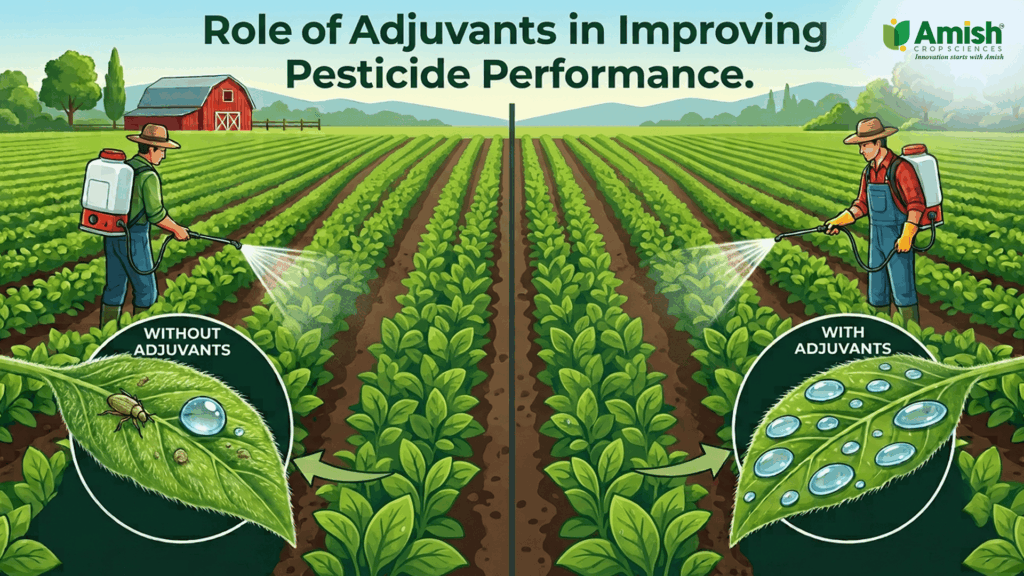
In modern farming, the selection of a suitable pesticide alone is not enough. To improve the efficiency and control of insecticides, fungicides, and herbicides in a field, proper application of these pesticides should also be considered. Various aspects, such as lack of proper coverage, spray drift, rainfall, hard water, and uneven absorption, may decrease the efficiency of the best crop protection chemical agents. This is where pesticide adjuvants come into play.
Adjuvants are special spray additives for crops that are added to the mixture of pesticides during spraying. While adjuvants themselves do not provide control of insects, weeds, or disease, they allow pesticides to have better coverage, adherence, penetration, and retention properties. Amicon is a silicone-based pesticide spreader produced by Amish Crop Sciences, and is one of these products.
Why Adjuvants Matter
There are some challenges faced by farmers in the process of applying pesticides. Waxiness or hairiness of leaves does not allow the droplets of spray to spread in an appropriate way, while rain at unexpected times can lead to washing of pesticides even before they get absorbed. Fine spray droplets can be blown away due to wind, and the use of hard water that contains elements like calcium and magnesium also diminishes the effectiveness of pesticides.
All these make the process of pest control less effective, waste chemicals, and add to the cost of production. However, using the appropriate adjuvants can help to overcome all these difficulties and improve the efficiency of spraying pesticides.
Benefits of Adjuvants
1. Improved Spray Coverage
Another major strength of using adjuvants is that they can enhance the effectiveness of the spray by improving the coverage rate. Adjuvants that have surfactants are able to lower the surface tension of water. This allows the spray to be spread evenly on the leaves, rather than just creating bead-like shapes.
An excellent illustration of such an adjuvant would be the Amicon spreader by Amish Crop Sciences. It has been created with the help of innovative organosilicone technology and gives the spray droplets an opportunity to spread quickly on leaf surfaces.
2. Enhanced Pesticide Uptake
Many modern pesticides are systemic and require better absorption into plant tissues for maximum effectiveness. Adjuvants improve spray penetration through the plant’s protective wax layer, enhancing pesticide performance.
Due to its property of ensuring faster and even distribution of the sprayed material on the leaves, it helps in ensuring better contact of the spray material with the plant.
3. Better Rainfastness
Unpredictable rains soon after spraying will cause pesticides to be washed away from crops, thus affecting their efficacy. Stickers are used to increase the binding ability of pesticide spray drops, making it possible for them to adhere to leaves after the rains or irrigation.
When used in a comprehensive spray program, it helps in achieving an even spray coating on the surface of the crop plants.
4. Reduced Spray Drift
Spray drift is a common challenge when it comes to windy weather. Small droplets have the ability to move off-target, making the use of pesticides ineffective and raising environmental issues.
Drift control additives will work to help enlarge droplets and limit the generation of mist in order to make sure that more pesticides land on the crops and not around the environment.
5. Improved Water Quality
The quality of water is critical in terms of its effects on the efficacy of the pesticides being used. Hard water has minerals that could make some formulations ineffective.
Water conditioner adjuvants help in counteracting the minerals present in the hard water, thus improving the stability of the spray mixture.
Common Types of Adjuvants
Depending on various farming conditions, pesticides will need different kinds of pesticide adjuvants. The following are some of the most widely used:
- Surfactants – To enhance spreading and wetting.
- Spreader – To ensure even spraying of the pesticide.
- Sticker – To increase the ability to adhere and withstand rain.
- Penetrant – To increase the ability of absorption of pesticides.
- Drift Control Agent – To control spray drifts.
- Water Conditioner – For effective spray when using hard water.
- Compatibility Agent – To prevent separation while mixing in tanks.
- Defoamer – To avoid excessive foaming during spray mixing.
Each one has its own role, and which to choose depends on the type of crops used, formulation of pesticides, weather conditions, and quality of water used.
Choosing the Right Adjuvant
Choosing the right adjuvant is critical when ensuring that pesticides work optimally. In this regard, farmers need to take into consideration various things such as the type of plant, pests, weather conditions, spray application equipment, and water quality, among others.
The use of a silicone spray adjuvant can significantly improve spray coverage on crops with waxy or difficult-to-wet leaves, ensuring better contact between the pesticide and the plant surface. Always follow the pesticide label instructions and recommended application guidelines for safe and effective use.
Best Practices for Maximum Performance
Farmers need to apply the following crop protection measures for optimal benefit:
- Use high-quality water.
- Use the recommended mixing sequence.
- Use proper adjuvant amounts.
- Use proper spray nozzles.
- Do not apply during windy and very hot weather.
- Perform spray calibration regularly.
- Perform compatibility tests before tank mixing.
By adopting the above practices, there will be efficiency in spray application and effectiveness of pesticides.
FAQs
A. An adjuvant is a material that is added to the pesticide solution to enhance the performance of the spray, such as spreading, retention, etc.
A. The addition of adjuvants increases the spray effectiveness, reduces spray drift, enhances rainfastness, etc.
A. It reduces the surface tension of water, which enables the droplets to spread over the plant surface uniformly.
A. Yes. Drift control adjuvants help to increase the droplet sizes and avoid fine mists.
Conclusion
Crop protection is achieved not only by choosing an appropriate pesticide but also by making sure that each spray operation is performed to obtain maximum effect. Pesticide adjuvants increase spraying efficiency and enhance pesticide absorption, coverage, and retention, thus assisting farmers in decreasing their losses and obtaining the best possible results in pest and disease elimination.
One of the most useful agricultural spray additives on the market today is Amicon from Amish Crop Sciences, which proves that using the appropriate silicone-based spreader makes a real difference when it comes to enhancing the performance of pesticides. With the appropriate pesticide and correct spray procedures, it assists farmers in maintaining healthy crops and higher productivity. In addition, in today’s agriculture, when farmers have been adopting more environmentally friendly methods of crop protection, Amicon is an easy step towards success.
Follow us on Instagram.